IUI Treatment in Indore: 5 Things Every Couple Should Know Before Starting

Dr. Vedant Jain
IVF Consultant & Gynecologist
October 16, 2026
11 min read
By Dr. Vedant Jain, MBBS, MS (OBGY), DNB | Asian IVF, Indore
When a couple visits me for fertility treatment, one of the first questions I hear is: “Doctor, should we try IUI before IVF?”
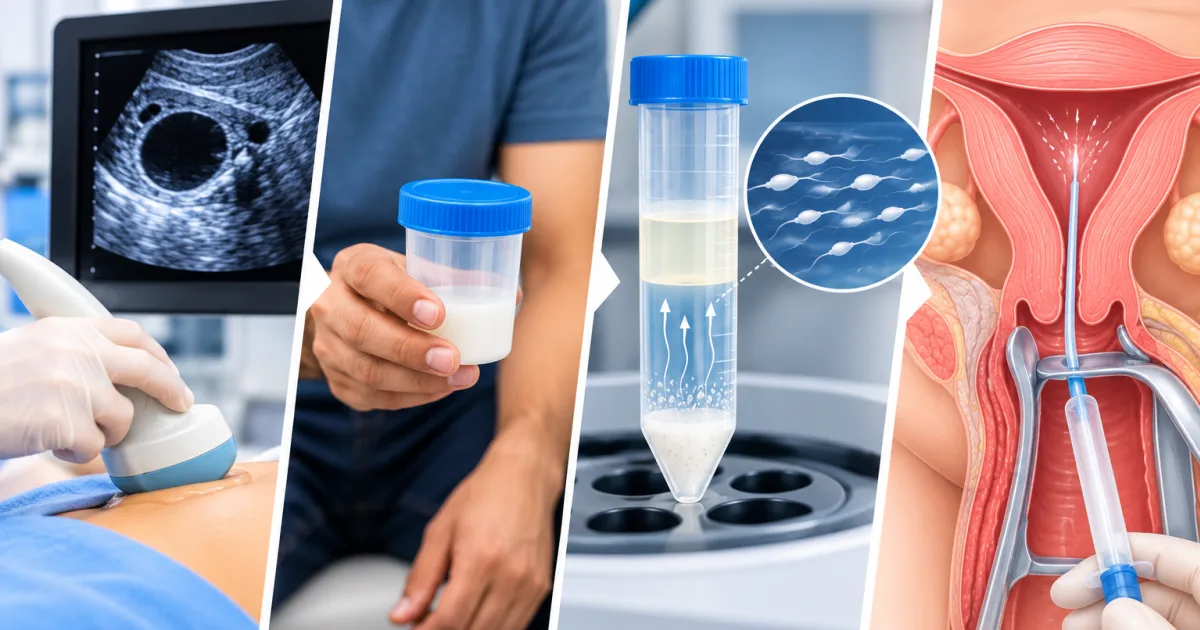
Intrauterine insemination (IUI) is a relatively simple fertility procedure. It involves preparing a semen sample in a laboratory and placing the processed sperm directly into the uterus around the time of ovulation.
But here is something every couple should understand: IUI is not simply about placing sperm inside the uterus. The right indication, timing, sperm preparation and treatment plan all matter.
IUI can be a reasonable first step for selected couples. However, it is not suitable for every type of infertility, and doing more procedures does not automatically mean a higher chance of pregnancy.
As a fertility specialist, I want patients to understand five important points before choosing IUI treatment in Indore.
1. IUI should be performed for the right indication—not just to increase pregnancy chances
One of the most common misconceptions about IUI is that it automatically increases the chance of pregnancy by 10–15% compared with trying naturally.
This statement is misleading unless it specifies the couple's diagnosis, age, treatment protocol and the outcome being measured. There is no universal 10–15% increase that applies to every couple undergoing IUI.
IUI does not correct every cause of infertility. Its usefulness depends on the problem we are trying to address.
When can IUI help?
IUI may be considered in selected cases of:
Mild male-factor infertility: When sperm count or motility is mildly reduced and an adequate number of motile sperm can be obtained after laboratory processing.
Cervical-factor infertility: When a cervical factor may interfere with sperm reaching the uterus.
Unexplained infertility: When the initial evaluation does not identify a clear cause, IUI combined with appropriate ovarian stimulation may be a treatment option.
Donor sperm treatment: When donor sperm is being used and the clinical circumstances are suitable.
Selected ovulatory disorders: When ovulation can be managed appropriately and the other fertility factors support IUI.
Before starting treatment, we should assess ovulation, the fallopian tubes, the uterus, the woman's age and the semen analysis.
When might IUI not be the best choice?
If both fallopian tubes are blocked, sperm numbers are severely reduced, ovarian reserve is a significant concern in the context of age, or there have been repeated unsuccessful treatment cycles, the couple may benefit from discussing other options, including IVF or ICSI.
The American Society for Reproductive Medicine (ASRM) recommends a course of ovarian stimulation with oral medication and IUI for many couples with unexplained infertility, followed by IVF if treatment is unsuccessful. The European Society of Human Reproduction and Embryology (ESHRE) also supports individualised treatment decisions based on the available evidence.
My advice: Before paying for an IUI cycle, ask your fertility specialist what specific fertility problem IUI is expected to overcome in your case.
2. Semen collection, laboratory processing and insemination should be well coordinated
The second important factor is the journey of the semen sample—from collection to processing and finally insemination.
A semen sample contains sperm cells along with seminal fluid. During IUI, the laboratory processes the sample to select a suitable population of motile sperm and remove seminal plasma and other unwanted components before insemination.
This requires trained laboratory staff, appropriate equipment, validated procedures and proper handling.
A well-coordinated clinic can reduce unnecessary delays between sample collection, preparation and insemination. This is particularly important when treatment is scheduled around ovulation.
Does the sample have to be collected inside the clinic?
Not necessarily. Home collection may be possible when the clinic's instructions and laboratory procedures permit it. The important points are correct collection, a suitable transport method, compliance with the laboratory's time and temperature instructions, and timely processing.
A study published in Fertility and Sterility examined 633 IUI cycles and found no difference in pregnancy rates between home and clinic collection when appropriate guidelines for the time from collection to use were followed.
Therefore, the meaningful question is not simply whether a clinic has an in-house laboratory. Ask how it handles samples, maintains appropriate conditions and coordinates processing with the planned insemination.
3. How long should the interval between semen collection and IUI be?
This is a practical question that deserves more attention.
Sperm are living cells, and their motility and functional quality can be affected by handling conditions. The sample should therefore be processed and used according to a validated laboratory protocol.
Patients sometimes hear that IUI must be completed within exactly 90 minutes of semen collection or that crossing this limit causes treatment failure.
There is no strong evidence establishing 90 minutes as a universal cutoff beyond which IUI will fail.
In the study mentioned above, the average time from collection to IUI was approximately 70 minutes in patients who conceived and 73 minutes in those who did not. These findings do not establish an exact deadline or prove that every longer interval is harmful.
However, they do support an important practical principle: sample handling should be planned carefully, unnecessary delays should be avoided, and the laboratory's validated protocol should be followed.
What should patients ask their clinic?
Is there a clear protocol for semen collection and transport?
Is the sample processed promptly after collection and liquefaction, as appropriate?
Are suitable temperature and handling conditions maintained?
Is the processed sample used in coordination with the planned time of insemination?
A well-organised IUI service should be able to explain its process clearly rather than relying on a rigid time limit that has not been established for every patient.
4. Sperm preparation is an important part of IUI treatment
Not all semen-processing methods are identical, and laboratory selection should be based on the sample's characteristics and the laboratory's validated protocol.
Two commonly used methods are:
Swim-up technique: Motile sperm are allowed to migrate into culture medium, helping the laboratory select a population of actively moving sperm.
Density-gradient centrifugation: The sample is separated using density-gradient media, helping to select sperm with suitable characteristics while removing much of the seminal plasma and other unwanted material.
The choice depends on factors such as sperm concentration, motility, the sample's characteristics and the laboratory's experience.
Does a particular technique guarantee pregnancy?
No. Neither swim-up nor density-gradient preparation guarantees fertilisation or pregnancy.
The objective is to obtain a suitable processed sample for insemination. The final result also depends on the woman's age, ovulation, tubal function, the number of motile sperm available after processing and other fertility factors.
Research published in the Journal of Pakistan Medical Association has examined swim-up as a method of semen preparation for IUI. More broadly, ESHRE's laboratory guidance emphasises appropriate procedures for sperm preparation and the handling of reproductive material.
When discussing IUI treatment in Indore, I encourage couples to ask how the laboratory chooses its preparation method and whether the post-processing semen parameters are reviewed before insemination.
5. Is double IUI better than single IUI?
Some clinics offer double IUI, in which insemination is performed twice during the same treatment cycle, often on consecutive days.
The reasoning is understandable: if one insemination is useful, perhaps two will improve the chance of conception.
But clinical practice should be guided by evidence rather than by the assumption that an additional procedure must be better.
A Cochrane systematic review published in 2021 examined nine randomised trials involving 2,751 women. The review found that the evidence was insufficient to establish whether double IUI improves live-birth rates compared with single IUI. Although some analyses suggested a possible increase in pregnancy rates, the evidence was of low quality, and the apparent benefit was not consistently demonstrated in higher-quality studies.
ASRM's guideline on unexplained infertility also concluded that live-birth rates were not significantly different between single and double IUI in the evidence it reviewed.
Does this mean double IUI should never be performed?
No. The evidence does not establish that double IUI is never useful in any circumstance. Rather, it does not support routinely assuming that two inseminations are superior to one for every patient.
For many couples, a properly timed single IUI is a reasonable approach. A second insemination should not be presented as a guaranteed way to improve pregnancy chances.
My advice: Ask your doctor why double IUI is being recommended, what evidence supports it for your particular situation, and whether the additional procedure is likely to change your treatment outcome.
What is the expected success rate of IUI?
There is no single IUI success rate that applies to every couple.
The chance of pregnancy depends on several factors, including:
The woman's age and ovarian reserve.
The duration and cause of infertility.
Whether at least one fallopian tube is open.
The number of mature follicles and the treatment protocol.
The number of motile sperm available after processing.
Previous fertility treatment and pregnancy history.
It is also important to distinguish a positive pregnancy test from a clinical pregnancy and from a live birth. These are different outcomes and should not be used interchangeably when comparing treatment results.
A responsible fertility consultation should discuss realistic expectations for your individual circumstances rather than promising a fixed percentage.
When should you consider IVF instead of repeating IUI?
IUI is less invasive than IVF, but it is not always the most effective next step.
IVF may be worth discussing when:
The fallopian tubes are blocked or significantly damaged.
There is severe male-factor infertility that may require ICSI.
Age and ovarian reserve make time an important consideration.
Several appropriately planned IUI cycles have been unsuccessful.
The diagnosis or previous treatment history suggests that IVF may offer a better chance of achieving a pregnancy.
For selected couples with unexplained infertility, ASRM recommends moving to IVF after a typical course of three or four cycles of ovarian stimulation with oral medication and IUI. The appropriate number of cycles can differ according to individual circumstances.
The aim is not to perform the maximum number of procedures. It is to choose a treatment plan that is medically appropriate for the couple.
Frequently asked questions about IUI treatment
What is IUI treatment?
Intrauterine insemination is a fertility procedure in which processed sperm are placed directly into the uterus around the time of ovulation.
Is IUI painful?
Most patients experience mild discomfort or cramping, if any. The procedure is usually brief and does not generally require anaesthesia.
How many IUI cycles should we try?
The answer depends on age, diagnosis, ovarian reserve, semen parameters and previous treatment. Many couples with unexplained infertility may be offered three times according to standard practice guidelines.
Is IUI possible if sperm motility is low?
IUI may be suitable in selected cases of mild male-factor infertility. The semen analysis and the number of motile sperm obtained after processing help determine whether IUI is reasonable.
Is double IUI necessary?
Not routinely. Current evidence does not establish a consistent improvement in live-birth rates with double IUI compared with single IUI.
word from Dr. Vedant Jain
For couples trying to conceive, fertility treatment can become emotionally and financially demanding. My approach is to begin with the diagnosis, explain the available evidence and help each couple understand the likely benefits and limitations of their options.
IUI can be a useful treatment when the indication is right and the cycle is planned carefully. But good fertility care is not about promising success or adding unnecessary procedures. It is about making informed decisions together.
If you are considering IUI treatment in Indore, the first step is a consultation that looks at both partners' fertility assessments and establishes whether IUI is the right treatment for you.
Consult Dr. Vedant Jain — Asian IVF, Indore
Phone: 9183690055 (book online consultation at-https://www.drvedantjain.com)
Book a consultation to discuss IUI, infertility evaluation and the treatment options appropriate for your circumstances.
Medical references
American Society for Reproductive Medicine (ASRM). Evidence-based treatments for couples with unexplained infertility: a guideline. Read the guideline.
European Society of Human Reproduction and Embryology (ESHRE). Evidence-based guideline on unexplained infertility. Read the guideline.
Rakic L, Kostova E, Cohlen BJ, Cantineau AEP. Double versus single intrauterine insemination for subfertile couples. Cochrane Database of Systematic Reviews, 2021. Read the review.
Song GJ, Herko R, Lewis V. Location of semen collection and time interval from collection to use for intrauterine insemination. Fertility and Sterility, 2007. Read the study.
Sperm swim-up: a simple and effective technique of semen processing for intrauterine insemination. Journal of Pakistan Medical Association. Read the study.
Share this article
Book an appointment
Consult with our specialist to know more.