Embryonic Stages of Development: What IVF Patients Should Know

Dr. Vedant Jain
IVF Consultant & Gynecologist
October 21, 2026
10 min read
# Embryonic Stages of Development: Understanding Your Embryo’s Journey During IVF
## Introduction: A Few Days That Matter
A few days can change everything in IVF.
After fertilisation, an embryo begins a remarkable journey of cell division and development. For couples undergoing treatment, these days can bring hope, anticipation and many questions. What happens after fertilisation? Why does the embryologist monitor embryos every day? And how much should couples read into the final embryo grade before transfer?
Understanding the embryonic stages of development can make this process less confusing. It also helps couples appreciate an important fact: **embryo development is a step-by-step process, and no single observation tells the entire story.**
At the Asian Institute of Infertility Management (AIIM), Indore, understanding this journey is an important part of explaining IVF treatment and helping patients make informed decisions.
## What Are the Embryonic Stages of Development?
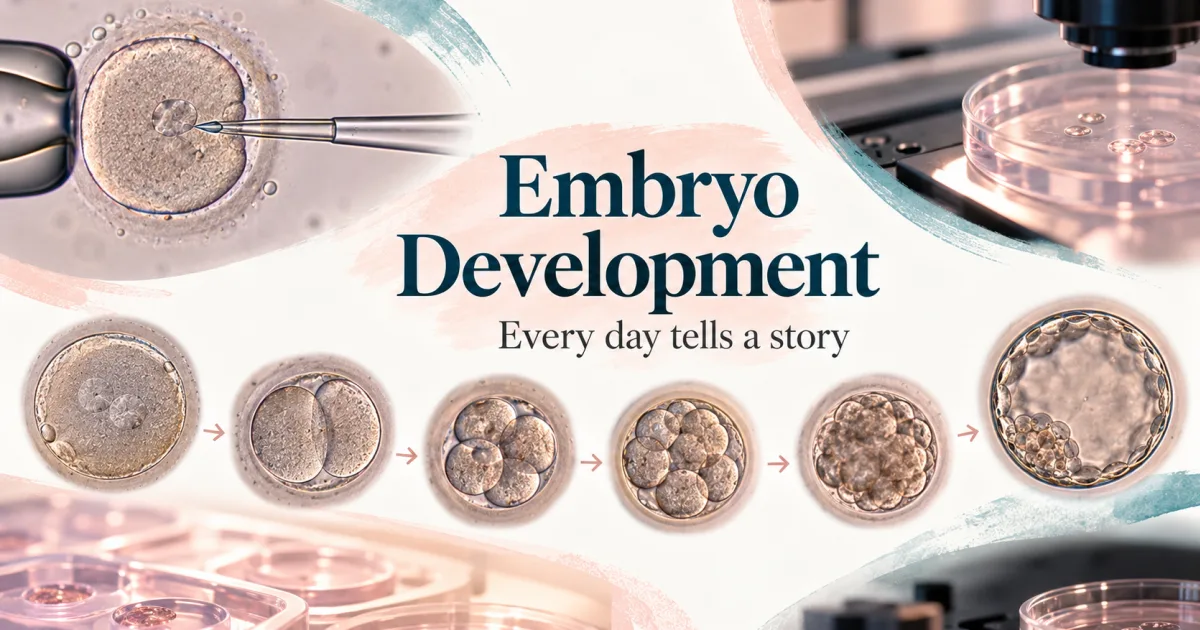
The embryonic stages of development describe the changes that occur after fertilisation, as the embryo progresses from a single cell through successive divisions to more advanced stages, including the blastocyst.
In IVF, embryologists observe this development under carefully controlled laboratory conditions. Each stage provides information about how the embryo is progressing and whether it is developing in a pattern consistent with its expected stage.
The process is not simply about reaching a particular day. It is about understanding what happens along the way.
### Why These Stages Matter in IVF
Embryo development is dynamic. Every day can bring new information.
An embryologist may assess whether the embryo is dividing at an appropriate rate, how many cells are present, whether the blastomeres appear reasonably uniform, and whether fragmentation or other developmental abnormalities are visible.
These observations help build a developmental picture over time. They can also guide discussions about continued culture, embryo selection and the timing of transfer.
A single snapshot may be useful, but the developmental pattern often provides additional context.
## What Happens After Fertilisation?
Fertilisation marks the beginning of embryonic development. The sperm and oocyte contribute genetic material, and the fertilised egg begins the process of development.
In conventional IVF or ICSI, embryologists assess fertilisation and then follow the embryo as it develops.
### Day 1: Fertilisation Assessment
The laboratory team commonly assesses whether normal fertilisation has occurred, typically looking for two pronuclei at the appropriate observation time.
This is an important early checkpoint. However, normal fertilisation does not guarantee that an embryo will continue developing or eventually implant.
### Day 2 and Day 3: Cleavage and Blastomere Quality
During the cleavage stage, the embryo divides into progressively more cells. These individual cells are called blastomeres.
Embryologists assess several features, including:
- **Cell number:** Whether the embryo has reached a cell number appropriate for its developmental timing.
- **Cleavage pattern:** Whether cell division appears orderly and consistent with expected development.
- **Blastomere quality:** The size, symmetry and appearance of individual cells.
- **Fragmentation:** The presence and extent of small cellular fragments between blastomeres.
- **Other developmental features:** Including multinucleation when it can be assessed reliably.
These details matter because embryos that look similar at one observation may have followed different developmental patterns.
However, morphology is not a direct test of chromosomal normality. Even an embryo with a favourable appearance may not implant, while an embryo with less favourable morphological features may still have reproductive potential.
### Day 4: Compaction
As development continues, the blastomeres begin to compact and establish closer contact with one another. This stage is associated with the formation of the morula.
Embryologists observe whether compaction is progressing as expected and whether the embryo is moving towards the blastocyst stage.
Not every embryo follows precisely the same timeline, so development must be interpreted in context.
### Day 5 and Day 6: Blastocyst Development
The blastocyst is a more advanced stage of embryo development. It contains a fluid-filled cavity, an inner cell mass that contributes to the developing fetus, and an outer layer of cells called the trophectoderm, which contributes to the placenta.
Blastocysts may be assessed according to their expansion, the appearance of the inner cell mass and the trophectoderm.
This assessment contributes to embryo selection. However, reaching the blastocyst stage or receiving a particular grade does not, by itself, establish whether an embryo is chromosomally normal or whether pregnancy will occur.
## Why Embryo Development Must Be Understood Day by Day
One of the most important things couples should understand about IVF is that **embryo development is a continuous biological process, not a competition based on a single grade.**
An embryologist does not simply wait until the day of transfer and then decide whether an embryo looks good. The team observes the embryo at defined stages, looking for new information as development progresses.
For example, an embryo may show an appropriate cleavage pattern on Day 2, while another may display slower or less coordinated division. By Day 3, additional information about blastomere number, symmetry and fragmentation may become available. By Day 5 or Day 6, the embryologist can assess whether the embryo has progressed to the blastocyst stage and evaluate its morphology.
Each observation adds another piece to the picture.
This does not mean that every embryo with a less favourable early observation will perform poorly, or that an embryo that develops well will necessarily result in a pregnancy. Rather, the purpose of monitoring is to interpret the available evidence as a whole.
## Should Couples Judge Their Embryos Only by the Final Grade?
No. The final embryo grade is important, but it should not be interpreted in isolation.
Couples naturally want a simple answer: Is this a good embryo? Will it implant? What are the chances of pregnancy?
Embryo grading helps embryologists compare morphological features and prioritise embryos for transfer or freezing. Yet a grade is a description of appearance at a particular stage. It is not a complete measure of reproductive potential.
The stage reached, the quality of the embryo at that stage, its developmental history and the wider clinical context all matter.
For example, a blastocyst grade provides information about expansion and the appearance of its component cell groups. It does not fully describe how the embryo divided during the earlier cleavage stages. Equally, an early cleavage-stage assessment cannot predict every subsequent developmental event.
**The most useful approach is to understand the embryo’s developmental journey alongside its assessment at the time of transfer.**
Couples should ask their fertility specialist to explain both the current findings and what those findings can—and cannot—tell them.
## Oocyte Quality, Sperm Quality and Embryo Development: The Bigger Picture
Embryo development does not occur independently of the egg and sperm from which the embryo originates.
Oocyte quality, sperm quality and the conditions in which fertilisation and embryo culture occur can all influence the developmental process. This is why an embryo’s final appearance should be considered as part of a broader fertility assessment.
### 1. Oocyte Quality
The oocyte contributes half of the embryo’s nuclear genetic material, as well as cellular structures and resources needed during early development.
Oocyte maturity is an important consideration during IVF and ICSI. Other aspects of oocyte competence are more complex and cannot be determined reliably from appearance alone.
Age is also relevant because the likelihood of chromosomal abnormalities in eggs generally increases with advancing maternal age. Nevertheless, neither age nor the appearance of an individual egg can tell the entire story about a particular embryo.
### 2. Sperm Quality
Sperm contribute the other half of the embryo’s nuclear genetic material. Semen analysis evaluates characteristics such as concentration, motility and morphology, but these measurements do not capture every aspect of sperm function.
In selected cases, additional investigations may be considered based on the couple’s history and clinical findings.
ICSI can help address certain fertilisation-related problems by injecting a selected sperm into an oocyte. However, it does not eliminate every sperm-related issue or guarantee normal embryo development.
### 3. The Stages of Embryo Development
After fertilisation, the embryo must continue through a sequence of developmental events.
Its cleavage pattern, blastomere characteristics, progression through compaction and development to the blastocyst stage all provide useful information.
These observations should be interpreted together rather than treated as independent guarantees of success.
The central message is simple: understanding embryo development requires consideration of the egg, the sperm and the embryo’s progress over time—not just the grade written on the transfer report.
How Does Embryo Monitoring Support IVF Decisions?
Embryo monitoring helps the embryology team understand which embryos are progressing and how their development compares with expected patterns.
Depending on the treatment plan, this information may contribute to decisions about continued culture, the timing of embryo transfer, embryo cryopreservation and which embryo to prioritise.
Not every embryo will reach the blastocyst stage. This can be emotionally difficult for couples, particularly when only a small number of eggs have been retrieved or fertilised.
It is important to understand that attrition can occur at different stages of development. The number of eggs retrieved, the number of mature oocytes, the number that fertilise normally and the number that reach the blastocyst stage are different measures. They should not be confused with one another.
Clear counselling helps couples understand these differences without interpreting every developmental change as a definitive prediction of the outcome.
## What Should You Ask Your Embryologist or Fertility Specialist?
Couples do not need to memorise every embryology term. A few practical questions can help them understand their treatment more clearly.
- How many oocytes were retrieved, and how many were mature?
- How many oocytes fertilised normally?
- How has the embryo developed at each assessment?
- What were the cleavage pattern, blastomere characteristics and fragmentation findings, where relevant?
- Has the embryo reached the blastocyst stage, and what does its grade mean?
- How are the embryo’s developmental history and current appearance being considered together?
- What factors related to egg quality, sperm quality or the clinical history might be relevant in our case?
A good consultation should explain the findings in understandable language. It should also acknowledge uncertainty, because embryo assessment can estimate developmental potential but cannot guarantee an individual outcome.
## Where Does This Fit Into Fertility Care in Indore?
IVF is one part of a broader fertility-care pathway. Some couples may first need evaluation for ovulation disorders, PCOS, tubal factors or male infertility. Others may benefit from IUI, ovulation induction, IVF or fertility preservation, depending on their individual circumstances.
At the Asian Institute of Infertility Management (AIIM), Indore, fertility assessment and treatment planning are intended to address the needs of the individual or couple rather than rely on a single treatment approach.
Embryology discussions are an important part of that process because they help connect laboratory findings with clinical decisions.
Conclusion: Look at the Journey, Not Just the Grade
Embryo development is a step-by-step process. From fertilisation and early cleavage to compaction and blastocyst formation, every stage offers information about the embryo’s progress.
A final embryo grade is useful, but it is not the whole story. Oocyte quality, sperm quality, developmental patterns and the embryo’s assessment at the time of transfer all contribute to the broader picture.
For couples undergoing IVF, understanding this journey can lead to better questions, clearer expectations and more informed conversations with their fertility team.
If you are exploring IVF or fertility treatment in Indore, a consultation with a fertility specialist can help you understand your individual findings and the options available to you.
Share this article
Book an appointment
Consult with our specialist to know more.