Azoospermia & Male Infertility specialist in Indore | Dr.Vedant Jain

Dr. Vedant Jain
IVF Consultant & Gynecologist
October 12, 2026
9 min read
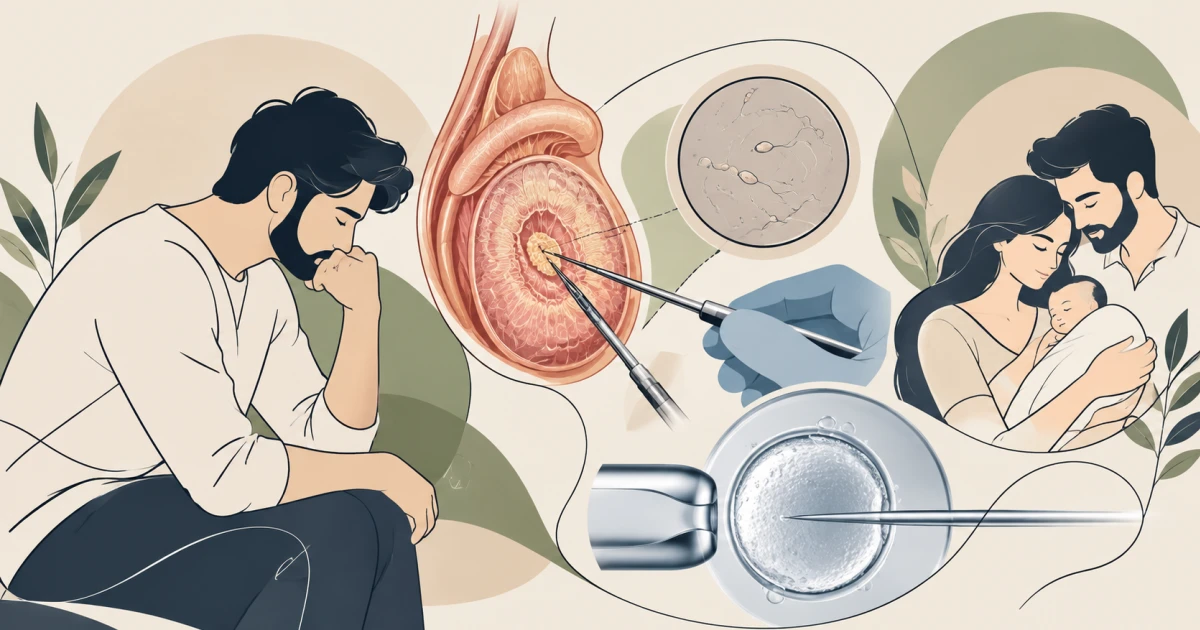
When a couple is told that there are no sperm in the semen report, the first reaction is often fear.
The word azoospermia can sound like the end of the fertility journey. But in many men, it is not.
Azoospermia simply means that sperm are not seen in the semen sample. The important question is why the sperm are absent.
Once the cause is understood, treatment can range from medicines and hormonal treatment to procedures such as TESA or TESE, followed by IVF-ICSI when appropriate.
What causes azoospermia?
Azoospermia is broadly divided into three groups.
1. Pre-testicular azoospermia
In this situation, the testicles may have the ability to make sperm, but the hormonal signals needed for sperm production are not working properly.
The brain, pituitary gland and testicles work together to control sperm production. Problems with this hormonal system can reduce or completely stop sperm production.
Some men may benefit from hormonal treatment once the underlying problem is identified.
This is why a man with azoospermia should not immediately be sent for a surgical sperm retrieval procedure without first understanding his hormones and clinical history.
2. Testicular azoospermia
Here, the main problem is with sperm production inside the testicles.
Possible causes include genetic conditions, previous testicular injury, infections, chemotherapy or radiation, undescended testis, certain medical conditions and severe impairment of sperm production without an obvious cause.
This is sometimes called non-obstructive azoospermia (NOA).
It is generally more challenging because the testicle itself may be producing very few sperm, or sperm production may be occurring only in small areas.
But even in some men with non-obstructive azoospermia, sperm can sometimes be found directly from the testicular tissue.
3. Post-testicular or obstructive azoospermia
Sometimes the testicles are making sperm normally, but the sperm cannot reach the semen because of a blockage in the reproductive tract.
This can happen because of previous infection, surgery, congenital absence of the vas deferens or other problems affecting the sperm ducts.
In such cases, sperm production may actually be quite good despite the semen report showing zero sperm.
Dr.Vedant Jain, ivf specialist in Indore believes that this distinction is extremely important because obstructive and non-obstructive azoospermia may require very different approaches.
The first step is not surgery
A diagnosis of azoospermia should generally be confirmed rather than being based on one semen report alone.
The evaluation may include repeat semen analysis, a detailed medical and surgical history, physical examination and hormone tests such as FSH, LH and testosterone.
Depending on the situation, doctors may also recommend genetic testing and other investigations.
The aim is to answer a simple question:
Are the testicles making sperm, and if they are, can those sperm reach the semen?
That answer helps decide what should happen next.
Can lifestyle changes improve sperm?
Lifestyle cannot correct every cause of azoospermia. If there is a complete obstruction or a significant genetic problem, simply changing lifestyle will not solve it.
But for men who have some sperm production, lifestyle can still matter.
Sperm take roughly three months to develop, so changes made today may take time to show up in a semen analysis.
Some basic habits are worth taking seriously:
* Avoid unnecessary heat exposure to the testicles.
* Avoid prolonged use of hot baths or excessive heat around the groin.
* Avoid unnecessarily tight clothing if it causes significant heat or discomfort.
* Stop smoking.
* Avoid tobacco in all forms.
* Keep alcohol intake low or avoid it.
* Maintain a healthy body weight.
* Exercise regularly.
* Get adequate sleep.
* Avoid recreational drugs and unnecessary medications that may affect fertility.
Smoking and tobacco exposure are particularly important. They can increase oxidative stress and damage sperm DNA. Some studies have also found an association between smoking and increased DNA fragmentation index (DFI).
So fertility is not only about the number of sperm.
Sperm quality and DNA integrity matter too.
What about medicines and supplements?
Treatment depends completely on the cause.
Some men with hormonal problems may benefit significantly from medical treatment. Depending on the diagnosis, treatment can include medicines that stimulate the body’s own hormonal system or injectable gonadotropins in selected patients.
Antioxidants and nutritional supplements are also commonly prescribed in male infertility. They may have a role in selected men, but they should not be considered a guaranteed treatment for azoospermia.
The important point is:
Do not start “testosterone boosters” or testosterone injections on your own when trying to have a baby.
External testosterone can actually suppress the hormones required for sperm production and may reduce or stop sperm production in the testicles.
A proper fertility evaluation should come before any hormonal treatment.
When is TESA or TESE considered?
If sperm cannot be obtained from the semen, doctors may consider retrieving sperm directly from the testicle.
Two terms patients commonly hear are TESA and TESE.
TESA — Testicular Sperm Aspiration uses a needle to aspirate testicular tissue and sperm.
TESE — Testicular Sperm Extraction involves taking a small piece of testicular tissue to look for sperm.
In men with non-obstructive azoospermia, a more extensive procedure called micro-TESE may be considered in appropriate cases.
The procedure chosen depends on the underlying diagnosis and the likelihood of finding sperm.
Where should TESA or TESE be performed?
This is one question I would encourage every patient to ask.
If surgical sperm retrieval is being considered for IVF-ICSI, I would prefer it to be performed in an IVF centre with an embryology laboratory available at the time of the procedure.
Why?
Because the embryologist can immediately examine the tissue and look for viable sperm.
If usable sperm are found, they may be used for ICSI and, when appropriate, additional sperm can potentially be cryopreserved for future treatment.
This can be particularly valuable because repeated testicular procedures are not something a patient should undergo casually.
The testicle is a delicate organ, and the risks and benefits of repeat procedures need to be discussed individually. Depending on the technique and clinical situation, repeated surgery can cause tissue damage and, rarely, affect testicular function.
So before undergoing TESA or TESE, ask:
“If you find sperm today, can you freeze some for future treatment?”
Ask about the sperm that was found — not just whether sperm was found
A report saying “sperm found” is encouraging, but it is not the entire story.
Ask your doctor and embryologist:
* Were viable sperm found?
* Were they sufficient for ICSI?
* What was the quality of the sperm?
* Were motile sperm seen?
* What was the amount of tissue obtained?
* Could additional sperm be frozen?
* What would happen if another IVF cycle is required?
These questions become particularly important when the first retrieval is difficult or sperm are found only in very small numbers.
What is the success rate of TESA or TESE?
This is where patients need to be careful with numbers found online.
There is no single success rate for TESA or TESE.
The chance of retrieving sperm depends heavily on whether azoospermia is obstructive or non-obstructive, the underlying diagnosis, hormone levels, testicular function, genetics and the surgical technique used.
In obstructive azoospermia, sperm retrieval is generally much more successful because sperm production may be preserved.
In non-obstructive azoospermia, sperm retrieval is more challenging, and micro-TESE is often preferred when surgical retrieval is indicated.
Similarly, asking whether unilateral or bilateral TESA/TESE has a higher “success rate” is not quite the right way to think about it. The need for one or both sides depends on the clinical situation and the surgeon’s findings. Bilateral surgery is not automatically better.
The goal should be to retrieve enough viable sperm while avoiding unnecessary testicular injury.
Finding sperm is not the final success
This is perhaps the most important point I discuss with patients.
A man may undergo TESA or TESE and hear:
“We found sperm.”
That is a major step.
But sperm retrieval itself is not the final goal.
The ultimate goal of fertility treatment is a healthy live birth.
There are several steps between finding sperm and having a baby: fertilisation, embryo development, embryo selection, transfer, implantation, pregnancy and ultimately live birth.
That is why couples should be careful when comparing clinics or procedures based only on a “sperm retrieval rate.”
A clinic may have an excellent sperm retrieval rate, but patients also want to know what happens after sperm are found.
Azoospermia does not mean giving up
At Dr Vedant Jain’s fertility practice in Indore, the focus is on looking at male and female infertility together rather than treating the semen report in isolation.
For couples dealing with azoospermia, the conversation should go beyond “Can we find sperm?”
It should be:
Why are there no sperm? Can we improve the underlying problem? If sperm retrieval is needed, what is the safest and most effective approach? Can sperm be preserved for future use? And ultimately, what gives this couple the best reasonable chance of taking home a healthy baby?
That is the way I believe azoospermia should be approached — not as a single abnormal semen report, but as a fertility problem that deserves a proper diagnosis.
A note from Dr Vedant Jain
A good clinical examination of the testicles can often give the surgeon useful clues about the possibility of finding sperm. It can also help decide whether a less invasive approach, such as PESA or needle-based TESA/mapping, may be reasonable before proceeding to a more extensive procedure such as TESE.
When sperm are successfully retrieved from the testicle, they are generally present in very small numbers and may have limited or no motility. These sperm are usually not suitable for IUI. Instead, they are typically used directly for ICSI, where an embryologist injects a suitable sperm into an egg to achieve fertilisation.
This is why surgical sperm retrieval and IVF-ICSI should ideally be planned together, with the urologist/andrologist and embryology team working closely during the procedure. The goal is not simply to find sperm, but to retrieve usable sperm safely, preserve them whenever possible, and give the couple the best possible pathway towards a healthy live birth.
Share this article
Book an appointment
Consult with our specialist to know more.